The Great Ranging
A Clash of KingsThe Great Ranging is the largest sustained military expedition undertaken by the Night’s Watch in the evidence presented. Its immediate purpose is to discover why wildling villages have been abandoned and what has happened beyond the Wall, but its deeper significance is the restoration of an old frontier alarm: the Watch is forced to recognize that the threat to the Seven Kingdoms is not merely scattered raiding or local disorder. Mance Rayder is gathering the wildlings in the Frostfangs, apparently preparing to strike south, while the expedition itself moves through a wilderness emptied of ordinary human life and marked by signs of an older, more terrifying conflict.
Purpose and Mobilization
The ranging is organized under Lord Commander Jeor Mormont, known among the brothers as the Old Bear. Mormont takes two hundred seasoned men, three-quarters of them rangers, while Qhorin Halfhand brings another hundred brothers from the Shadow Tower. The force is therefore not a casual patrol but a carefully reinforced penetration of the haunted forest, composed chiefly of men trained to scout, survive, and fight beyond the Wall. Its scale also explains why those left behind at Castle Black are expected to maintain the Watch’s ordinary functions while the expedition advances into danger.
The expedition requires more than fighters. The Old Bear takes two cages of ravens so that the Watch can send reports as the column proceeds. Maester Aemon is too frail and blind to ride, so Samwell Tarly goes in his place, helping with the ravens and the written messages. Jon Snow is told that the ranging will be as safe as returning to his father’s castle at Horn Hill, but the reassurance is immediately undercut by the history of recent losses. Too many rangers have disappeared or died, including Benjen Stark, and two of Benjen’s men were found slain before rising again as wights. The mission is thus framed by the gap between official confidence and remembered evidence.
The March Beyond the Wall
The Watch leaves Castle Black in relatively good spirits, but the mood changes as the column travels deeper into the wilderness. At Whitetree, the fourth abandoned village, Mormont records that the settlements are empty and the wildlings have gone. Jon rides within a formal military column: Jarman Buckwell’s scouts lead, Thoren Smallwood commands the vanguard, Mormont follows with the main force, Ser Mallador Locke brings the baggage train and packhorses, and Ser Ottyn Wythers commands the rear guard. The expedition numbers two hundred men and roughly three hundred mounts, a structure that combines reconnaissance, command, transport, and protection rather than relying on individual heroics.
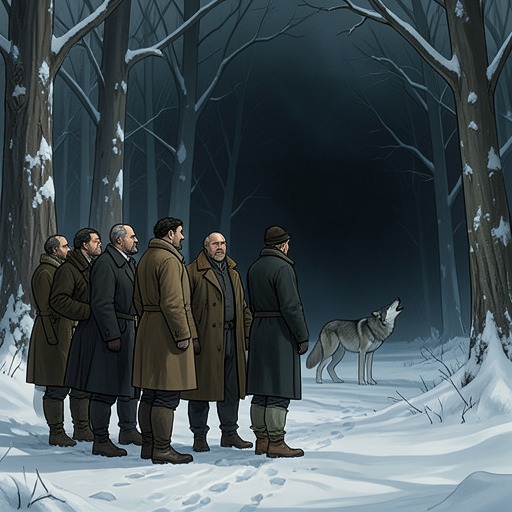
The men follow game trails and streambeds called ranger’s roads, moving through leaf and root by day and camping beneath the stars at night. They watch the red comet overhead, but the more immediate sign is the forest’s silence. Four villages stand empty, the wildlings cannot be found, and even the game seems to have fled. Jokes become rare and tempers shorten. The brothers refuse to admit fear because they are men of the Night’s Watch, yet Jon Snow senses their unease, and veteran rangers agree that the haunted forest has never seemed more haunted. The expedition’s progress therefore produces not reassurance but accumulating absence: every missing village enlarges the unknown.
The coming winter intensifies that uncertainty. Jon Snow has seen the great white raven from the Citadel bring Maester Aemon word that summer is ending. He remembers a winter from childhood, but it had been short and mild; this one feels different, something he can sense in his bones. The Wall itself dominates the expedition’s world, an icy cliff seven hundred feet high whose changing colors make it seem almost alive. It stretches beyond sight in both directions, reducing Castle Black’s towers and keeps to insignificance and making the Wall appear not simply a fortification but the edge of the known world.
Mance Rayder and the Emerging Threat
The apparent disappearance of the wildlings is explained at Craster’s Keep. Mormont learns from Craster that Mance Rayder is gathering his people in the Frostfangs. The information confirms what Ser Denys Mallister had already heard from a captured wildling in the Gorge, but Craster supplies the decisive detail of place. The empty villages are not evidence that the wildlings have vanished; they are evidence that they are concentrating elsewhere.
Mormont does not know whether Mance Rayder is building a city or an army. The Frostfangs are a cruel wilderness of stone and ice that cannot sustain a great population indefinitely, and the Watch has no reliable count of the wildlings or of the men among them who can fight. Mormont nevertheless sees only one plausible purpose in such a gathering: Mance Rayder intends to strike south into the Seven Kingdoms. The Great Ranging therefore changes the Watch’s understanding of the crisis. Its investigation turns a pattern of local disappearances into a strategic threat involving movement, concentration, leadership, and invasion.
This revelation also exposes the limits of the Watch’s authority. Mormont tells Jon Snow that Craster is his own man, has sworn no vows, and is not subject to the Watch’s laws. The brothers cannot simply impose their moral judgment on every community beyond the Wall; their purpose is not to set the entire world right, but to fight the wars that threaten the realm. The ranging must consequently balance investigation against discipline, survival against intervention, and the Watch’s sworn neutrality against the growing pressure of events beyond its borders.
The Fist of the First Men
The expedition establishes a fortified position at the Fist of the First Men, a solitary hill rising above the forest and visible for miles. Its bare brown slopes and stone-knuckled summit resemble a fist punching through the earth, while a chest-high wall of fallen rocks crowns the top. Mormont considers it excellent ground and orders the force to camp there while awaiting Qhorin Halfhand. The site gives the ranging a defensible center in a landscape otherwise defined by concealment and uncertainty.
The Fist also links the military present to an ancient past. Its name comes from the wildlings, and its age makes it plausible that it preserves remnants from peoples who lived in the far North long before the current kingdoms. That buried history becomes physically present when Jon Snow and Ghost uncover a recently hidden bundle. Inside are a dozen knives, leaf-shaped spearheads, numerous arrowheads, and other weapons made of dragonglass, the black volcanic substance the maesters call obsidian.
The cache is accompanied by an old warhorn made from an auroch’s horn and banded in bronze. Beneath the weapons lies a black cloak of a sworn brother of the Night’s Watch. The materials create a disturbing combination of antiquity and recent concealment: the dragonglass may belong to an ancient cache of the children of the forest, yet the woolen cloth is damp but not rotted and could not have been long underground. The discovery suggests that the expedition is moving through a region where old weapons, forgotten enemies, and recent Watch activity overlap. The Fist is not merely a campsite; it is a repository of buried histories and a warning that the men’s present mission may be connected to conflicts older than their order.
Military Logic and the Wider War
The Great Ranging occurs within a realm already being reorganized by war. Robb Stark’s fresh bronze-and-iron crown presses heavily on his head as he claims an independent kingdom north of the Neck and across the Riverlands, while the banner of the King in the North remains the grey direwolf of House Stark running across an ice-white field. Renly Baratheon argues that a throne belongs to the man who can win it, recalling that Robert Baratheon won the Iron Throne with his warhammer; Robb’s independence and Renly’s claim both reveal how political authority is being remade through armies, allegiance, and symbols rather than settled succession alone.
The same military transformation appears in the southern campaigns. At Storm’s End, Catelyn Stark sees Stannis Baratheon’s encircling army reduced by distance to the size of mice beneath the ancient castle. At the Blackwater Rush, Stannis’s fleet is arranged in ten lines of twenty ships, with archers and spearmen intended to land beneath the city walls and slower vessels carrying the main host across the river. When the raised chain across the Blackwater catches the galleys, ships crash into it and burn amid red-hot steel, blazing wood, and green flame. The contrast clarifies what makes the northern expedition distinctive: the Great Ranging is not a siege or a fleet battle, but a long reconnaissance in which geography, silence, logistics, and concealed movement are the primary enemies.
The expedition’s frontier mission also stands against Theon Greyjoy’s invocation of the Old Way. Theon remembers that Aegon the Dragon destroyed the ironborn practice of reaving by burning Black Harren and returning his kingdom to the rivermen, while the Greyjoy words still proclaim, “We Do Not Sow.” His desire to restore that order belongs to the same fractured political season, when old identities are being revived as weapons. Yet the Great Ranging reveals a danger that cannot be contained by any claimant’s border or ancestral slogan. The Night’s Watch may be divided from the wars of kings, but what gathers beyond the Frostfangs threatens every kingdom alike.
Significance and Narrative Frame
The Great Ranging is narrated through ordinary chronological scenes, primarily filtered through Jon Snow’s experience and observations rather than presented as a detached military report. That perspective makes the expedition legible through bodily impressions: burned fingers that must remain flexible for sword use, fear remembered through the blue eyes and cold hands of a wight, the difficulty of the march, and the changing morale of the brothers. The mission’s strategic meaning emerges gradually from these local perceptions instead of being announced at the outset.
Its most powerful pattern is the substitution of animal and supernatural knowledge for human certainty. Bran Stark longs to understand the wolves’ howls and remembers that Summer, Shaggydog, and Grey Wind sensed deaths before the human characters understood them. Daenerys Targaryen insists that her three dragons are hers because they were born through faith, death, and fire, making living dragons a source of power no man may take from her. During the night of the great battle on the Blackwater, wolves perceive fire, blood, horses, and human terror from the edge of the woods, then find the camps burned and the bodies abandoned. Against this wider pattern, Ghost’s discovery of the dragonglass at the Fist suggests that the nonhuman and the ancient may perceive the coming catastrophe more clearly than the institutions still trying to name it.
The ranging begins with confidence in numbers, command, maps, ravens, and seasoned rangers. It proceeds through abandoned settlements and an increasingly haunted forest, receives its strategic explanation at Craster’s Keep, and reaches an ancient stronghold whose soil conceals weapons and a black cloak. Its decisive achievement is not victory but recognition: the Night’s Watch learns that the wildlings are gathering under Mance Rayder and may be preparing a southward invasion. The expedition turns the Wall from a remote boundary into the active front of the story, where the political fragmentation of the kingdoms meets a threat that predates their quarrels and may outlast them.